Abstract
The report aims to analyze the trend in unemployment of the country post liberalization till the year 2017-18 and understand the causes and consequences of it. Since the major portion of the country’s population consists of the youth of the country, the target population of this report is the age group between 15-29 years.
Introduction
The study focuses on the disturbing patterns of the level of unemployment of youth in the country. It tries to identify the reasons which have led to the rise in the unemployment level of the youth in the country when the total unemployment level is falling. The indicators being used for the study are labour force participation rate, worker population ratio and literacy rate. The time period of the study is 1991-2018.
Analysis
Unemployment has always been a serious macroeconomic issue in the Indian economy. Post liberalization, the opening of Indian markets brought in lot of foreign capital, encouraged trade and gave a boost to the Indian economy. However, the Indian domestic market was severely hit as it could not withstand the foreign competition. Especially the Indian market for agricultural commodities and the traditional handloom and textiles. This created a lot of unemployment, wage inequality and poverty. Hence, the Indian society got divided into two sections – the rich and the poor. It was during the time period 1983 to 2005 that India’s labour force was growing at a rate of 2.5 percent and employment opportunities were increasing at 2.3 percent only. This posed a challenge in front of the Indian market as it had to provide jobs to all those who were already unemployed as well as new entrants in the market. This means that a situation was created where in which labour supply was in excess of labour demand and an increase in the rate of unemployment contributed to already existing level of employment further aggravating the situation. In the year 2008, out of the 60 percent of the employed workforce, 90 percent of them were working in the unorganized sector. A global financial crisis in the following year further aggravated the situation and led to a drastic fall in the exports of the country and effected the GDP of the country adversely. However, in contrast with the countries around the world, India managed to withstand the financial crisis thanks to the savings done by the Indian public which didn’t affect the demand for goods and services in the Indian domestic market and the Indian economy was not as adversely affected as expected.
It was during the time period 2011-12 that the pattern of unemployment in the country started experiencing a very disturbing trend. On one hand the level of total unemployment in the country started experiencing a fall whereas, on the other hand, the proportion of unemployed youth that is the age group between 15-29 years experienced a rise. The table below shows a fall in the level of total unemployment during the time period 2011-2012.
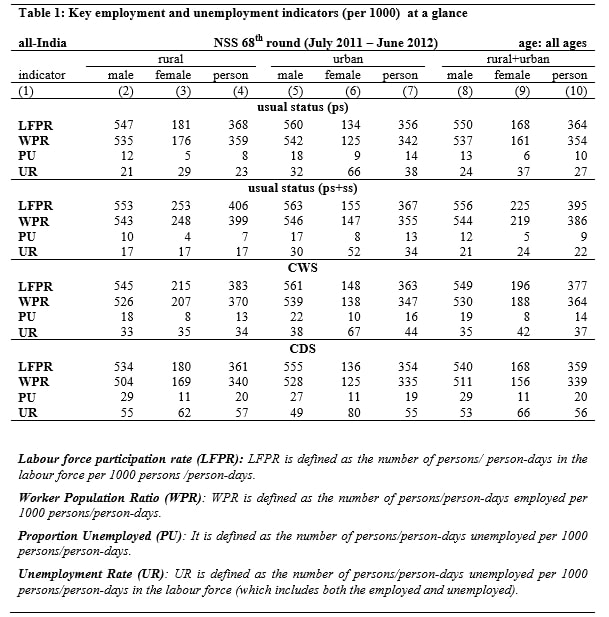
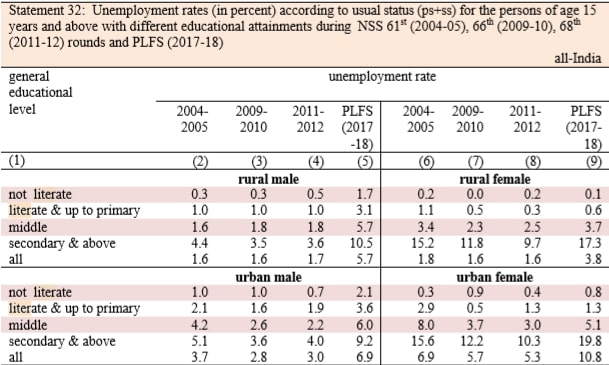
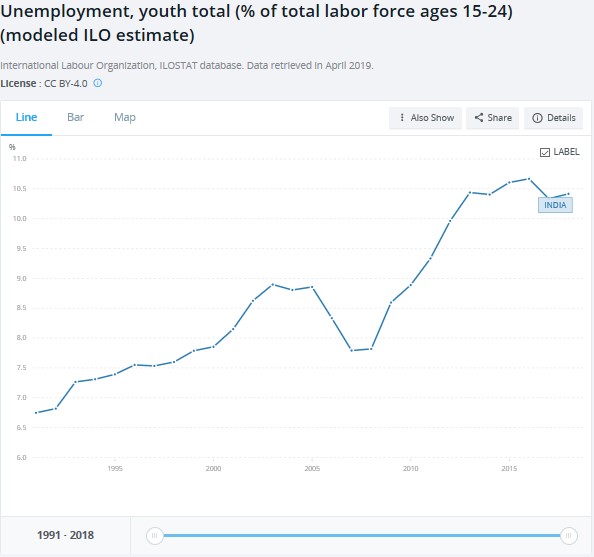
In the year 2013-14 the rate of unemployment rose to 4.9 percent from 4.7 percent of previous year. This could be due to increase in literacy rate. As after receiving primary and secondary education, the major proportion of the youth might have thought of pursuing higher studies or creating their own startups and the same trend can be very evidently seen for the successive years till 2018. As can be seen in the table above, with increase in literacy rate every year, there is simultaneous increase in the level of unemployment of youth between the age group of 15-24 years as can be seen in the line graph below.
Causes
As can be very evidently seen from the table and the graph below, the labour force participation rate is falling from the time period 2011-12 to 2017-18. The reason behind this is more and more youth between the age group of 15-29 years now prefer pursuing higher studies.

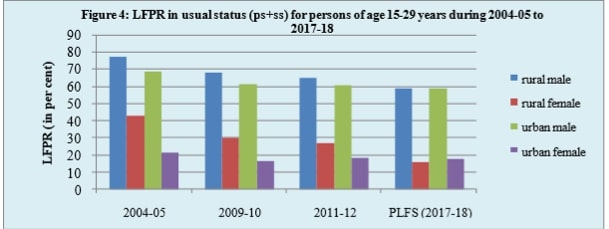
Also, an increase in literacy rate leads to an increase in the level unemployment thus, reducing the size of the employed workforce. This kind of unemployment is known educated unemployment. Another indicator leading to the same conclusion is WPR.
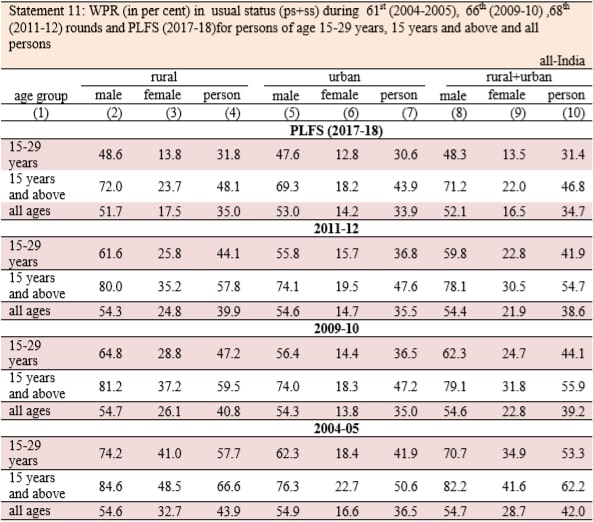
The worker population ratio shown in the table above signifies the increase in educated unemployment over the recent years. This is because of reasons like lack of job opportunities, skill development, need for higher studies, and high population.
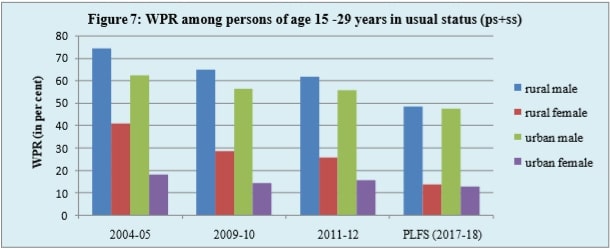
The graph above shows the decline in WPR.
Consequences
A high proportion of Unemployment specifically among the educated youth of the country would hamper the country’s growth and development in the long term. As lack of availability of jobs for youth would deteriorate the quality of population as it would prompt the youth of the country to indulge in actions like theft, murder, etc. Also, this might severely hit the GDP of the Indian economy. Hence, the government needs to come up with policies that would encourage the educated youth be to walk on right path and build a better future for the country.
References
https://data.oecd.org/emp/employment-rate.htm
https://journals.sagepub.com/doi/full/10.1177/2158244015579517
 Unemployment in India